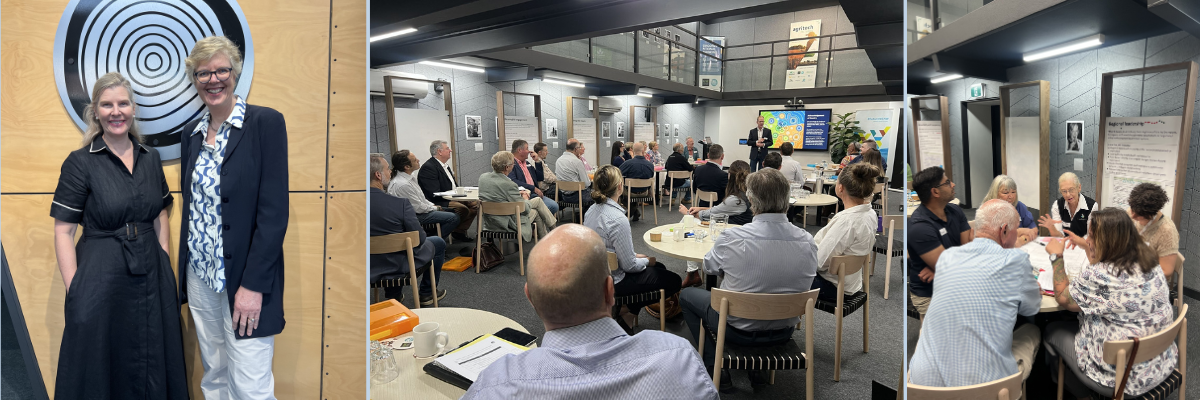
Dr Lou Conway – Country Universities Centre and Local Leader reflects on the pragmatic conversations held across the Business, Community and Youth Leader Roundtables held in Armidale March 2026, and the desire to translate goodwill into meaningful action and benefits for the region.
“The appetite for action is real and the leadership is ready. A National Regional Energy Accord gives us a framework to move from discussion to implementation and to build something that adds value to the whole community.”
There is genuine goodwill toward the energy transition in the New England. That was clear across every one of the Regional Energy Accord Roundtables we held in Armidale recently with business leaders, community members and young people.
What people wanted to talk about was whether the hosting of large-scale energy infrastructure will genuinely benefit the communities living with it and how we achieve the coordination, transparency and accountability needed so that communities can see there is something in it for them.
Open to the transition, clear about the terms
Communities across the New England are actively seeking information about timing, risk, benefits and the cumulative effects of large-scale energy development. It is important to understand how it will reshape landscapes, stretch housing and infrastructure, and change the character of towns and districts. People are willing to engage in this discussion, but only if the process is honest, well-informed and the outcomes will be shared.
We heard repeatedly that communities hosting energy generation and transmission infrastructure deserve improved energy reliability and affordability. Not just the burden of hosting but real benefits and new economic opportunities that stay in the region. This matters because it shifts the conversation from compensation to active participation.
Fragmentation is the risk – Coordination is the response
If there was one message that cut across every Roundtable, it was that the biggest risk to the energy transition in our region is misinformation and fragmentation in the implementation process.
Where energy proponents are engaging directly with individual landholders, often without meaningful notification to local councils, councils are fielding questions from their communities about project timelines, impacts and benefits without having a clear picture themselves. There’s a steady churn of developer approaches and consultations that rarely adds up to clarity or consistency.
The consequences are serious. Community tension is escalating. Trust is eroding and the people in the middle — the large, reasonable middle who are genuinely open to the transition are being left without answers.
A national Regional Energy Accord built on principles of transparency and accountability would require energy businesses to engage early, openly and consistently before projects are locked in, not after. It would give regions the tools to understand cumulative effects, recognising that individual project approvals don’t adequately account for the combined impact of multiple developments on landscapes, communities, infrastructure and services. What the Roundtables confirmed is that this needs to be backed by shared data on project pipelines, scenario planning across the region, and mechanisms that make coordination a core feature of how development proceeds.
Transparency that’s built into the process
Across the Roundtables, participants kept returning to a simple proposition: if promises are being made, there should be a way to track them. A Commitments Register so communities can see who promised what, and by when. A clear source of truth on project pipelines and impacts. Regular public reporting on what’s been delivered, and support for the Future Fund as an example of capturing benefits being led by Armidale Regional Council. These components were confirmed as building the infrastructure of trust.
Young people see the opportunity
Our youth leaders brought some of the most compelling perspectives to the Roundtables. They recognise the urgency of the transition, and they see it as a catalyst for generational change but only if it translates into jobs, liveability and a genuine reduction in cost of living.
They expect to be involved meaningfully and continuously. Young people were mobilising around an intergenerational benefit principle insisting that the transition must create lasting prosperity through skills, infrastructure and economic diversification that endure well beyond construction.
We have the ingredients – What we need is the architecture
One of the things that struck me most across the Roundtables was the quality of what already exists in this region. Collaborative relationships between councils with credible regional leadership and strong convening capability. Business leaders who know how to calculate risk and continuity for their businesses. Community leaders who are constantly tracking community needs and building social infrastructure in health, housing, childcare, family support, to name a few. The presence of UNE which is ready to play a far deeper role supporting workforce development, research, innovation, and acting as a stable, neutral steward for regional coordination over time.
There is recognition that a coordination framework, transparency mechanisms, accountability structures would turn regional goodwill into a managed process with real outcomes.
Community wellbeing is how we’ll know
Underneath all of this, the coordination, the transparency, the accountability, the benefit-sharing sits a deeper conviction that ran through every Roundtable: the energy transition cannot be treated as purely an infrastructure challenge. It is a social and human one.
A successful transition strengthens the things that enable regional life to work. Long-term local jobs leveraging new economic opportunities, affordable energy and better infrastructure. Real pathways for young people, with housing that works and health services that keep pace. These are the basics that business, community and young people are asking for.